Business Process Automation: 5 Ways It Can Transform Your UK Small Business
Time is the most valuable resource any small business has. Yet most small business owners and their teams spend a significant chunk of each working day on repetitive, manual tasks, entering data, sending routine emails, chasing approvals, generating reports, and moving information from one system to another.
Business process automation (BPA) is about using technology to handle these routine tasks automatically, freeing your team to focus on work that genuinely requires human judgement, creativity, and expertise.
Here are five of the most impactful ways automation can transform your UK small business.
1. Automating Invoicing and Financial Admin
For many small businesses, billing and invoicing involves a time-consuming manual process: creating invoices from a template, sending them by email, chasing overdue payments, and reconciling payments against the ledger. Each step takes time, and manual processes introduce the risk of errors.
Automating your invoicing workflow means invoices are generated and sent automatically when a job is completed or a milestone is reached. Payment reminders go out on schedule without anyone having to remember. Payments are reconciled automatically when they arrive. The result is faster cash flow, fewer errors, and hours reclaimed every week.
2. Streamlining Customer Onboarding
Getting a new customer up and running efficiently makes a strong first impression and sets the tone for the relationship. But onboarding typically involves multiple steps across multiple systems: sending welcome information, collecting data, creating accounts, assigning team members, and scheduling initial actions.
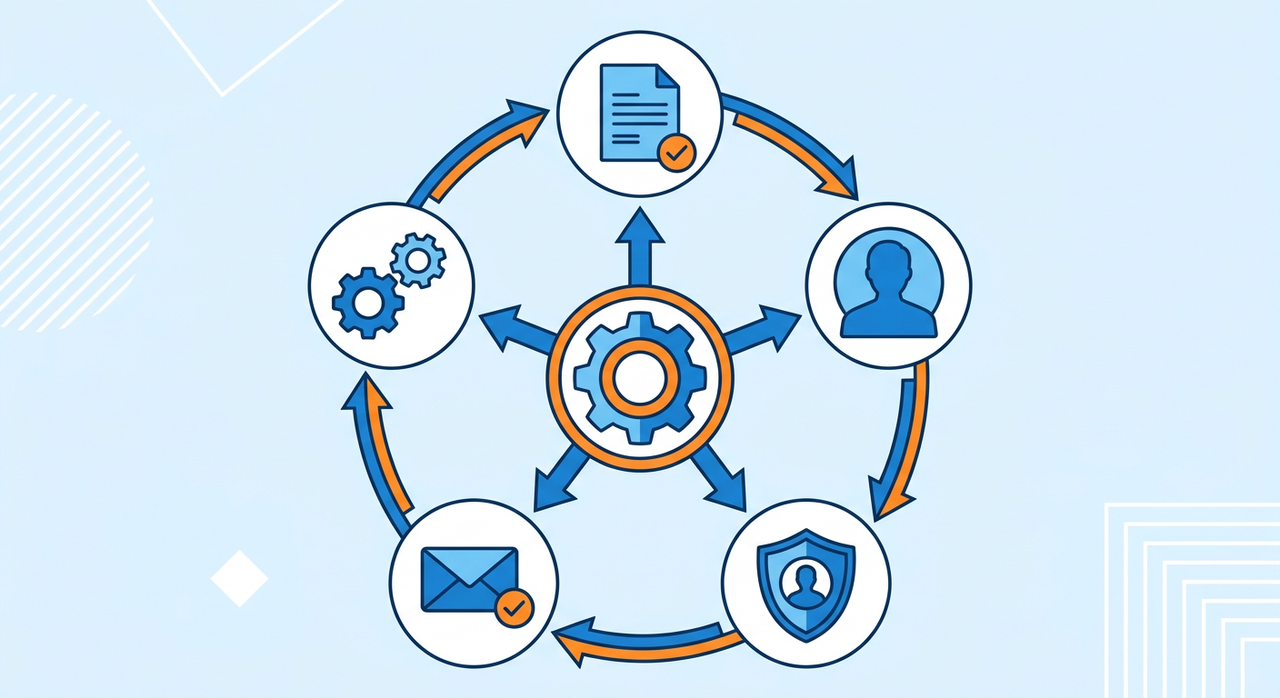
Without automation, each of these steps requires manual intervention. With automation, a trigger, such as a signed contract or a completed form, can kick off an entire onboarding workflow automatically: sending welcome emails, creating records in your CRM, assigning tasks to team members, and scheduling follow-ups.
This kind of workflow automation, delivered through our business automation services, means new customers get a consistent, professional experience every time, regardless of who’s in the office.
3. Automating Internal IT Processes
IT administration involves a surprising amount of repetitive work: creating and removing user accounts, onboarding new starters, managing software licences, and running routine maintenance tasks.
Automated IT workflows can handle much of this without manual intervention. When a new employee joins, automation can provision their accounts, set up their email, assign software licences, and add them to the relevant groups, all triggered by an entry in your HR system. When someone leaves, the same automation revokes access across all systems simultaneously, reducing the risk of security gaps.
This kind of IT process automation is central to what we deliver through our managed IT support service.
4. Automating Communications and Follow-Ups
Staying in touch with customers, prospects, and partners is crucial for business development, but it’s time-consuming when done manually. Automation allows you to build intelligent communication workflows that trigger based on customer behaviour or business events.
For example: a prospect fills in a contact form and receives an immediate response, followed by a helpful follow-up sequence. A customer who hasn’t re-ordered in 60 days gets a personalised check-in. A resolved support ticket automatically triggers a satisfaction survey. These automations keep relationships warm and ensure no opportunity falls through the cracks.
5. Connecting Your Business Systems
One of the biggest productivity drains in any small business is having information siloed across multiple systems that don’t talk to each other. Your CRM holds customer information; your accounting software holds financial data; your project management tool holds task information. Moving data between them manually is tedious and error-prone.
Modern application development and automation platforms make it straightforward to connect these systems so that data flows automatically. A new customer in your CRM is created in your accounting software. A completed project triggers an invoice. A new stock order updates your inventory and notifies the relevant team member.
Getting Started
The best approach is to start small: identify one or two manual processes that are time-consuming and repetitive, and automate those first. A good starting question for your team is: “What do you do every day or every week that feels like it should happen automatically?”
At HGC IT, our business automation team works with UK small businesses to identify, design, and implement automation solutions that deliver real time and cost savings. Get in touch to discuss how automation could benefit your business, or call us on 01305 310006.