More customers, councils and insurers now ask small businesses for a Cyber Essentials certificate. The good news is that it is designed for organisations like yours, and it is far less work than most people expect.
This guide explains what's involved and what the official assessment costs. If you would rather have someone take you through it, see our Cyber Essentials certification service.
Your Cyber Essentials checklist: the five controls
Cyber Essentials is a UK government-backed certification that shows your business has the basic protections in place against the most common cyber attacks. It is run by IASME on behalf of the National Cyber Security Centre, and it must be renewed every year.
It is built around five technical controls. Check each of these before you buy the assessment:
- Firewalls that protect your internet connection.
- Secure configuration, so devices and software are set up safely rather than left on default settings.
- User access control, so people only have the access they need and admin accounts are protected.
- Malware protection on your devices.
- Security update management, so software is kept up to date and anything unsupported is removed.
For what changed in this year's rules, see our guide to Cyber Essentials and Plus in 2026.
What's involved: the route a small business follows
- Prepare. IASME lets you download the question set and the requirements document for free before you pay, so you can see exactly what you will be asked.
- Buy the assessment. From that point you have six months to complete and submit it.
- Answer the questions. A senior person in the business must confirm the answers are accurate.
- Assessment. An assessor from a certification body reviews your answers. IASME says most aim to respond within three days.
- Fix anything simple. If you are unsuccessful, you have two working days to sort out simple issues and resubmit without paying again. After that, the fee is payable again.
- Certification. Your certificate lasts 12 months, then you renew.
One rule catches out a lot of small businesses: any unsupported software in scope, such as an old version of Windows, is an automatic fail. It is worth checking your devices before you buy the assessment.
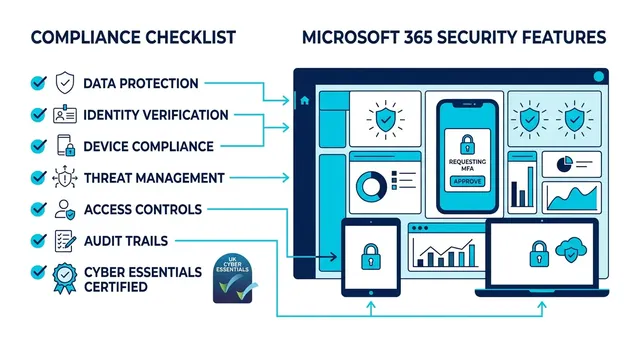
For many small businesses, most of the work is in Microsoft 365 settings, so our guide to Microsoft 365 compliance and Cyber Essentials is a useful next read. If you supply defence customers, our guide to Cyber Essentials scope for defence suppliers explains what needs to be included.
The Cyber Essentials Plus audit
Cyber Essentials Plus uses the same five controls, but an assessor also carries out a hands-on technical audit, including vulnerability scanning and checks on a sample of your devices. IASME says that if you achieved Cyber Essentials less than three months earlier, you should not need to repeat the self-assessment stage.
What it costs: the official IASME assessment fees
These are IASME's published fees for the Cyber Essentials assessment itself. They are set by your organisation's size:
Organisation size | Employees | Assessment fee |
|---|---|---|
Micro | 0–9 | £320 + VAT |
Small | 10–49 | £440 + VAT |
Medium | 50–249 | £500 + VAT |
Large | 250 or more | £600 + VAT |
Source: IASME Cyber Essentials FAQs.
Cyber Essentials Plus is quoted individually, because the cost depends on the size and complexity of your network.
A 75% discount for first-time applicants
IASME's First Step Fund currently offers a 75% discount on a new Cyber Essentials assessment for UK organisations with fewer than 250 staff that are certifying for the first time, or have not held a certificate in the last four years. With the discount, IASME shows the fees as £80 + VAT for 0–9 staff, £110 + VAT for 10–49 and £125 + VAT for 50–249.
The assessment must be bought before 31 March 2027 and completed within six months, and funding is limited. See IASME's First Step Fund page and the government's Cyber Essentials funding package for the full rules.
What HGC's support costs
The IASME fee covers the assessment only. If you would like help preparing, fixing any gaps and keeping your business compliant through the year, that is priced separately. Every business starts from a different place, so ask us for a fixed quote.
A certificate is a snapshot, not the whole year
Cyber Essentials shows your business met the requirements on the day it was assessed. Staying protected means keeping devices updated, managing accounts as people join and leave, and checking settings haven't drifted before your renewal. Our Cyber Essentials service is built around keeping you compliant all year, not just passing once.
IASME also notes that eligible UK organisations with turnover under £20 million that certify their whole organisation may receive included cyber insurance. For more on what insurers expect, see our guide to cyber insurance requirements for UK small businesses.
Not sure where you stand?
Book a free IT review and we'll tell you how close you are to Cyber Essentials, what needs fixing, and a fixed quote to get you certified. Call us on 01305 310006.